Caminos de Agua and Aqueous Solutions is holding the following event on July 25-31, 2016:
SPECIAL TOPICS IN WATER SUPPLY & TREATMENT FOR DEVELOPING COMMUNITIES —
AN INTENSIVE PARTICIPATORY WORKSHOP
Key Concepts + Hands-On Practicum
WHEN: JULY 25 – 31, 2016
WHERE: Via Organica Ranch, San Miguel de Allende, Mexico
APPLICATION DEADLINE: MAY 15, 2016
[ early bird discount available for registrants before March 31, 2016 ]
APPLY ONLINE here.
Course Topics Include
- Biochar for Control of Persistent Organic Pollutants
- Bone Char for Control of Inorganic Contaminants
- Slow Sand Biofiltration | Ceramic Filtration
- Rainwater Harvesting & Safe Storage | Solar-PV Pump Supply
- Gravity Fed Water Supply in Rugged Terrain
The abstract of this article is reposted from the February 2016 issue of the Centers of Disease Control and Prevention’s Emerging Infectious Diseases journal.
The risk for cholera infection is >100 times higher for household contacts of cholera patients during the week after the index patient seeks hospital care than it is for the general population. To initiate a standard of care for this high-risk population, we developed Cholera-Hospital-Based-Intervention-for-7-Days (CHoBI7), which promotes hand washing with soap and treatment of water. To test CHoBI7, we conducted a randomized controlled trial among 219 intervention household contacts of 82 cholera patients and 220 control contacts of 83 cholera patients in Dhaka, Bangladesh, during 2013–2014. Intervention contacts had significantly fewer symptomatic Vibrio cholerae infections than did control contacts and 47% fewer overallV. cholerae infections. Intervention households had no stored drinking water with V. cholerae and 14 times higher odds of hand washing with soap at key events during structured observation on surveillance days 5, 6, or 7. CHoBI7 presents a promising approach for controlling cholera among highly susceptible household contacts of cholera patients.
Reposted from the Government of Mexico in January
The prevention and control actions “Wash, Cover, Flip and Throw out” remain essential for the prevention of Dengue, Chikungunya and Zika in Mexico.
Zika virus infection is a disease caused by a virus that is transmitted through the bite of the Aedes aegypti mosquito, transmitter of the same vector of Dengue and Chikungunya. It was first isolated in a monkey in the Zika forest in Entebbe, Uganda (Africa); since 1968 outbreaks have been reported from this disease in tropical Africa and parts of Southeast Asia.
In March 2014, was identified the presence of Zika virus infection in the Americas, and in November 2015 was confirmed the first indigenous case of Zika virus infection in Mexico.
In Mexico, January 8, 2016 have been confirmed 15 indigenous cases of infection Zika virus in the states of Chiapas (10), Jalisco (1) and Nuevo Leon (4), while there have been three cases imported in Queretaro (1), Nuevo Leon (1) and Tamaulipas (1).
On January 17, 2016, the Pan American Health Organization has reported that there are 18 countries that have confirmed indigenous circulation of Zika virus (ZIKV) between 2015 and 2016: Brazil, Barbados, Colombia, Ecuador, El Salvador, Guatemala, Guyana, French Guyana, Haiti, Honduras, Martinique, Mexico, Panama, Paraguay, Puerto Rico, St. Martin, Suriname and Venezuela.
Zika virus infection is characterized by:
- Fever.
- Conjunctivitis.
- Headache.
- Muscle pain.
- Rash.
- Itch.
- Shaking chills.
There is no specific treatment and as for Dengue and Chikungunya, the treatment is only symptomatic and for relieve pain and fever. There is no vaccine to prevent the infection of this virus.
It is important to note that Brazil has reported an association between microcephaly and Zika virus infection in pregnant women. Microcephaly is a neurological disorder in which the circumference of the head is less than average for a baby of their size or age. This country has reported the occurrence of three deaths attributed by Zika virus infection.
Since May 2014 in Mexico have taken steps to prevent Zika virus infection through prevention campaigns and health promotion, preventive travel advisories, warnings and epidemiological actions for vector control.
Mexico´s Epidemiological Surveillance System is ready for diagnosis of infections by Zika virus.
In addition to the prevention and control of the vector, in the coming days it will spread a campaign in media about the importance of preventing Zika virus infection especially among pregnant women, to prevent complications such as microcephaly.
It is necessary to continue spreading the following recommendations:
Recommendations to the public:
- Wear long sleeves, trousers and repellent.
- Wash the containers in which you save water and cover them.
- Turn buckets and bottles and strip what you do not use and can accumulate water
- Keep doors and windows closed, place mosquito nets and sleeping pavilions.
Pregnant women besides these recommendations should attend prenatal checkups.
We hope that in the coming weeks or months the disease will disperse in the country.
By Aparna Rau, Source: UNICEF Media Center : http://www.unicef.org/uganda/media_16796.html
.jpg) Communities in the Dei fish landing site in the Panyamur Sub County of Uganda’s Nebbi District were falling prey to cholera outbreaks on a daily basis, due to consistently drinking contaminated water from Lake Albert. To tackle this troubling issue Water, Sanitation and Hygiene (WASH) experts at UNICEF Uganda sought to find innovative water solutions far different from those used in the past. Taking India’s idea of the Milk ATM one step further, UNICEF Uganda in partnership with Water Mission Uganda (WMU), created one of the first Water ATM’s in the country, launching the first pilot project in the Dei parish of Panyamur in December of 2013, which serves a population of over 8,000.
Communities in the Dei fish landing site in the Panyamur Sub County of Uganda’s Nebbi District were falling prey to cholera outbreaks on a daily basis, due to consistently drinking contaminated water from Lake Albert. To tackle this troubling issue Water, Sanitation and Hygiene (WASH) experts at UNICEF Uganda sought to find innovative water solutions far different from those used in the past. Taking India’s idea of the Milk ATM one step further, UNICEF Uganda in partnership with Water Mission Uganda (WMU), created one of the first Water ATM’s in the country, launching the first pilot project in the Dei parish of Panyamur in December of 2013, which serves a population of over 8,000.
LifeLink, the Water ATM designed by the Danish company Grundfos, enables villagers to purchase between 5 and 20 litres of clean water (100 UGX, or $3 cents for 20 litres), using a water key that allows for both mobile banking and point of sale payment. The ATM machine dispenses safe water. Raw surface water is directly pumped from Lake Albert through a filtered water treatment system, engineered by Water Missions International, which chlorinates to disinfect water from germs that cause water borne diseases; the clean water is then delivered to an elevated gravity pressure water tank, all using solar power technology.
Both a Water Agent and a security guard, selected from Dei parish community, have been trained to manage day-to-day ATM operations. The Water Agent is paid UGX 200,000 (or $58) as a monthly salary and 10 per cent of the sales made from the ATM. A Water Agent Manager from WMU supports the overall running of the system. When a key is used LifeLink automatically captures the data, enabling the system to monitor clean water usage, as well as its own performance from anywhere in the world, using a remote management web application. If an issue occurs that requires maintenance, an SMS and email message is sent to operations services staff to ensure that a consistently reliable water supply is available year round.
With the aim to inspire positive behaviour change, the Water ATM project includes a village health and hygiene promotion component, in which WASH volunteers from the community are trained to go door to door creating awareness on good practices in: hand washing, household and food cleanliness, and latrine usage. Since the introduction of both the Water ATM project and social mobilization campaign, there have been almost no incidents of cholera for the past two years, while over 60 per cent of households in the Dei parish have built and started using latrines.
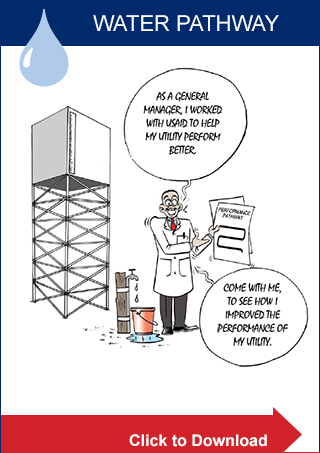 The SUWASA Pathway is a tool developed to share experiences, deliver key messages and provide links to useful resources such as manuals, case studies, templates and reports. The SUWASA Pathway was developed by the SUWASA team in consultation with project partners including officials from government ministries, municipalities and regulatory agencies, utility managers, managers of dedicated funding units, private operators, commercial bank representatives, civil society and development partners. The objective of the Pathway is to communicate complicated reform topics in a highly accessible manner to a broad range of sector stakeholders and to assist with envisioning and sequencing reform efforts. There are many possible reform paths, but the SUWASA Pathways offer viable reform routes.
Available for download and viewing:
Household water treatment and safe storage – effectiveness and economics. Drink. Water Eng. Sci. Discuss., 8, 143–176, 2015.
Authors: S. M. L. Stubbé, A. Pelgrim-Adams, G. L. Szanto, and D. van Halem.
Household Water Treatment and safe Storage (HWTS) systems aim to provide safe drinking water in an affordable manner to users where safe piped water supply is either not feasible or not reliable. In this study the effectiveness, costs and cost drivers 5 of three selected HWTS systems were identified. The selected systems are SODIS, ceramic filter and biosand filter.
These options were selected based on their current usage rate, available scientific data, and future potential. Data was obtained through peer-reviewed literature, reports, web-pages and informal sources. The findings show a wide dispersion for log removal of effectiveness of the HWTS systems.
The reported costs of HWTS systems show a wide range as well. The price per cubic 15 meter water is found to be EUR 0–8 (SODIS), EUR 0.37–6.4 (ceramic) and EUR 0.08– 12.3 (biosand). The retail prices found are: negligible (SODIS), USD 1.9–30 (ceramic) and USD 7–100 (biosand). No relationship was observed between removal efficiency and economics of the three systems.
Innovative WASH interventions to prevent cholera. Source: WHO Wkly Epid Rec, Oct 2, 2015
Authors: Daniele Lantagne, Andy Bastable, Jeroen H. J. Ensink, and Eric Mintz.
In the late 19th and early 20th centuries, epidemic cholera was virtually eliminated in industrialized countries through municipal water supply with treatment and sanitation infrastructure.1 A century later, in 2014, only 58% of the global population had access to piped-on premises water,2 and an estimated 1.8 billion people (28% of the global population) drank microbiologically contaminated water.3 Within this inadequate water and sanitation context, cholera transmission continues.
In 2014, 32 countries – many of which are struggling with poverty, rapid population growth, and instability – reported cholera transmission.4 A recent model found that national improved water access of 71%, and improved sanitation access of 39%, predicted whether a country would have endemic cholera with 62%–65% sensitivity and specificity.5 As progress is made towards universal access to reliable piped-on-premises water, reducing the remaining cholera burden requires a comprehensive strategy. Community- and household level water, sanitation, and hygiene (WASH) interventions are one part of that strategy.
Common cholera-prevention WASH interventions include: water supply, water treatment (well, pot, or bucket chlorination and household treatment); sanitation options (latrines); and, promotion of hand washing and environmental hygiene.6 The effectiveness of these interventions varies7 : water supply and chlorine-based, filtration, and solar disinfection household options have been shown to reduce cholera transmission among users;8, 9, 10, 11, 12 well/pot chlorination effectively treats water only for a few hours,13, 14, 15 unless chlorine is regularly added;16 there is little research on bucket chlorination, sanitation, and hygiene interventions.
Recent innovations in chlorine-prevention WASH include identification of factors leading to programmatic success, and new product design (such as sourcebased water treatment and personal use sanitation options).
An investigation of 14 household treatment programmes implemented in 4 emergencies (including 3 cholera emergencies) found that reported use ranged from 1% to 93% and effective use (the percentage of recipients who improved their drinking water microbiological quality to international standards) ranged from 0 to 68%.17 The most successful programme provided an effective method (chlorine tablets), with the necessary supplies to use it (bucket and tap), and ongoing training by local community health workers to people using contaminated water who were familiar with chlorination before the emergency. Conversely, the least successful programme distributed only chlorine tablets in a relief kit labeled in English to populations without previous chlorination experience.
Similar results were found in an evaluation of dispensers, an innovative source-based intervention that includes a chlorine dispenser and dosing valve installed at water sources, community education, and chlorine refills. Across seven evaluations in four emergencies (including 3 cholera emergencies), reported dispenser use ranged from 9-97% and effective use from 0 to 81%.18 More effective programmes installed dispensers at point-sources, maintained a high-quality chlorine solution manufacturing and distribution chain, maintained hardware, integrated dispenser projects within larger water programmes, compensated promoters, had experienced staff, worked with local partners to implement the project, conducted ongoing monitoring, and had a sustainability plan.
The Peepoo is a personal, single-use, biodegradable selfsanitizing double-plastic bag toilet. Peepoos contain sufficient powdered urea to inactivate harmful pathogens in urine and feces after 4 weeks, at which time the waste can be used as fertilizer. Peepoos have been used where latrines are not feasible due to population density, and to bridge the gap between emergency onset and latrine construction.19 One emergency programme concluded that products should be pre-positioned before the emergency, all products necessary for use (including a sitting/squatting stool) should be provided to recipients, training for community health workers should occur before distribution, compensation for collection activities should be provided, and that the disposal mechanism and exit strategy should be predefined before distribution.
As can be seen, lessons learned from the programmes described above are similar: WASH interventions can successfully improve water quality, isolate feces from the environment, and reduce the potential for cholera transmission if they are wisely implemented and distributed with appropriate supplies and training to at-risk populations.

Acceptability and Use of Portable Drinking Water and Hand Washing Stations in Health Care Facilities and Their Impact on Patient Hygiene Practices, Western Kenya. PLoS One, May 2015.
Authors: Sarah D. Bennett, Ronald Otieno, Tracy L. Ayers, Aloyce Odhiambo, Sitnah H. Faith, Robert Quick, Hans-Joachim Lehmler
Many health care facilities (HCF) in developing countries lack access to reliable hand washing stations and safe drinking water. To address this problem, we installed portable, low-cost hand washing stations (HWS) and drinking water stations (DWS), and trained healthcare workers (HCW) on hand hygiene, safe drinking water, and patient education techniques at 200 rural HCFs lacking a reliable water supply in western Kenya. We performed a survey at baseline and a follow-up evaluation at 15 months to assess the impact of the intervention at a random sample of 40 HCFs and 391 households nearest to these HCFs. From baseline to follow-up, there was a statistically significant increase in the percentage of dispensaries with access to HWSs with soap (42% vs. 77%, p<0.01) and access to safe drinking water (6% vs. 55%, p<0.01).
Female heads of household in the HCF catchment area exhibited statistically significant increases from baseline to follow-up in the ability to state target times for hand washing (10% vs. 35%, p<0.01), perform all four hand washing steps correctly (32% vs. 43%, p = 0.01), and report treatment of stored drinking water using any method (73% vs. 92%, p<0.01); the percentage of households with detectable free residual chlorine in stored drinking water did not change (6%, vs. 8%, p = 0.14). The installation of low-cost, low-maintenance, locally-available, portable hand washing and drinking water stations in rural HCFs without access to 24-hour piped water helped assure that health workers had a place to wash their hands and provide safe drinking water. This HCF intervention may have also contributed to the improvement of hand hygiene and reported safe drinking water behaviors among households nearest to HCFs.
Morphology, composition and performance of a ceramic filter for household water treatment in Indonesia. Water Practice & Technology Vol 10 No 2 pp 361–370 © IWA Publishing 2015 doi:10.2166/wpt.2015.044.
Authors: K. Matthies, H. Bitter, et al.
People in rural developing areas often depend on point-of-use water treatment for safe drinking water. A very popular and efficient technology for this is the use of ceramic filters, as promoted by the non-governmental organization Potters for Peace. These filters are already used in many countries worldwide, including Indonesia, where they are manufactured in Bandung, Java by Pelita Indonesia. The filters are made of local clay and combustible material, and coated with silver after firing. However, data available on them are very scarce. The structure, composition, and physico-chemical and microbiological performance of the filter were examined. Pore sizes mostly ranged from 1 to 40 µm and flow rate was about 1.3 L/h. Silver, arsenic and manganese were leaching from the filter in remarkable concentrations. While values for silver were about 0.01–0.02 mg/L, manganese was washed out after a few liters and leaching of arsenic fell below 0.02 mg/L after filtering some liters. With a log reduction of 3–5, efficiency in bacteria reduction was satisfactory in contrast to virus removal which was not sufficient according to the World Health Organization guidelines, with a log reduction below 1.